Skip to content
ProductGate, weigh and movesLoad proofProof of deliveryInspectionsClaims with evidenceCarrier and container checksThe UmbrellaThe platform in full
SolutionsCarrier appointmentsGate managementYard mapDock schedulingFreight and documentsDwell and alertsYard management
AppsPartnerGoYard
Pricing
CompanyAboutProduct videosGuidesDriver privacySecurityCareers
Talk to our team

Inspections

Every gate, dock and yard walk, on the record.

Inspections happen where the work happens. Gate checks, dock checks, yard audit walks and trailer condition are captured on the same visit, so damage is dated before it becomes a dispute.

yard.flodock.com

See it at the dock door

The inspection happens where the trailer is, not afterwards.

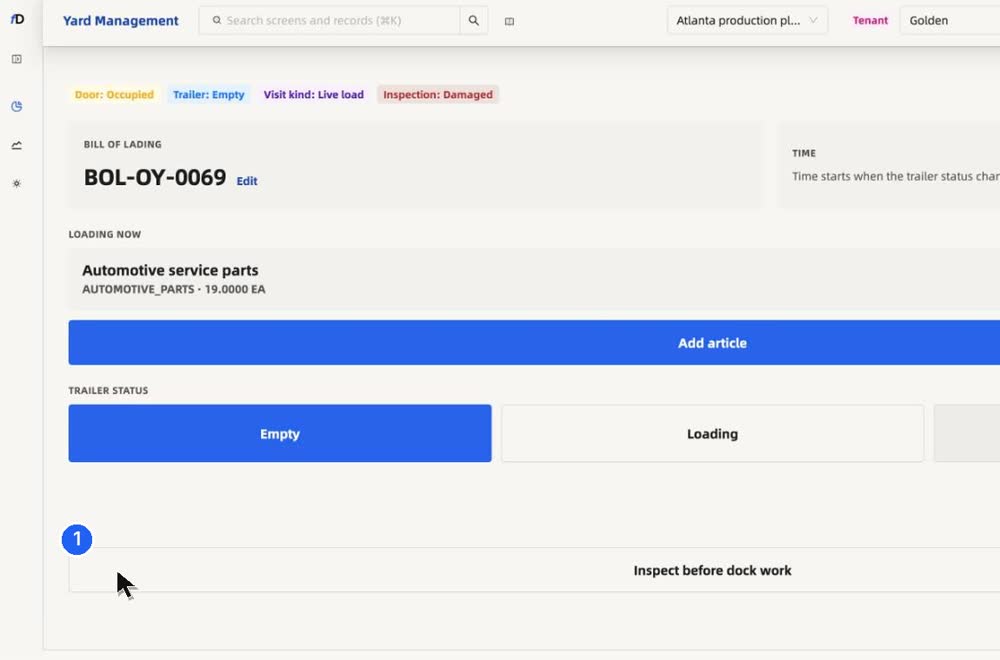
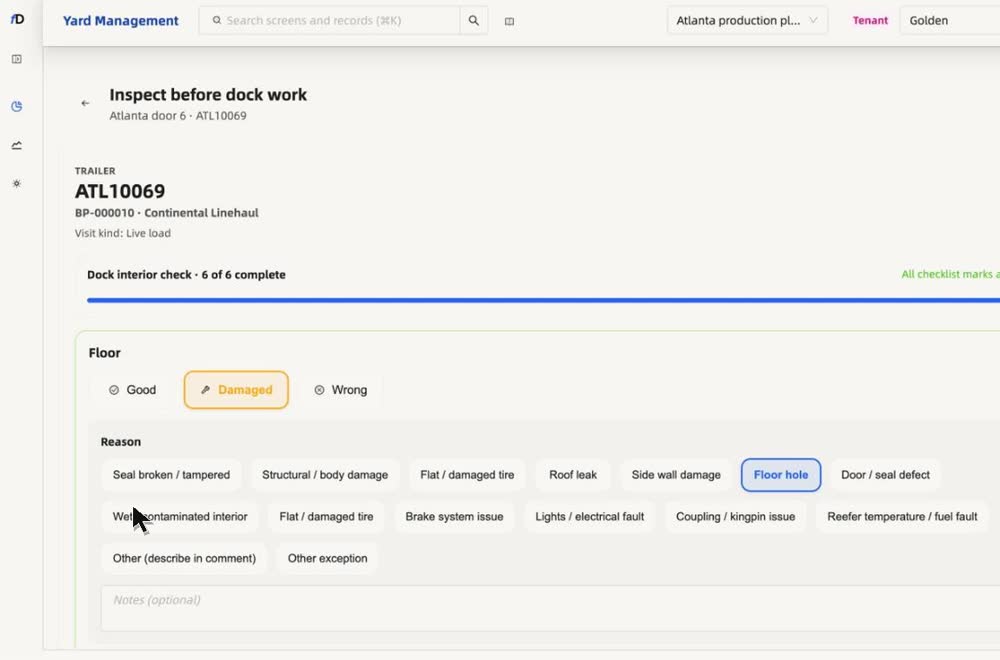
The dock tablet walks the person at the door through floor, side walls, roof and more, one tap each: good, damaged or wrong. Then an overall trailer condition and an in-service or out-of-service call. It is saved on the visit before any work starts.

  • One tap per areaGood, Damaged or Wrong. No free-text hunt, so it is fast enough to be done every time.
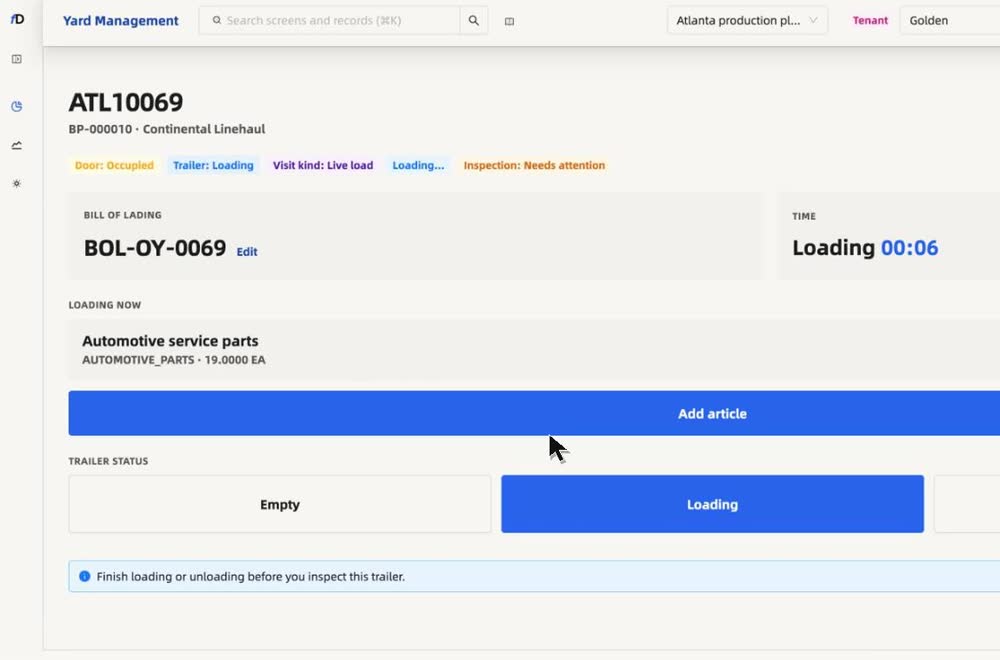
  • Blocked until it is doneThe screen asks for an overall trailer condition before work continues, so the check is not skipped when the dock is busy.
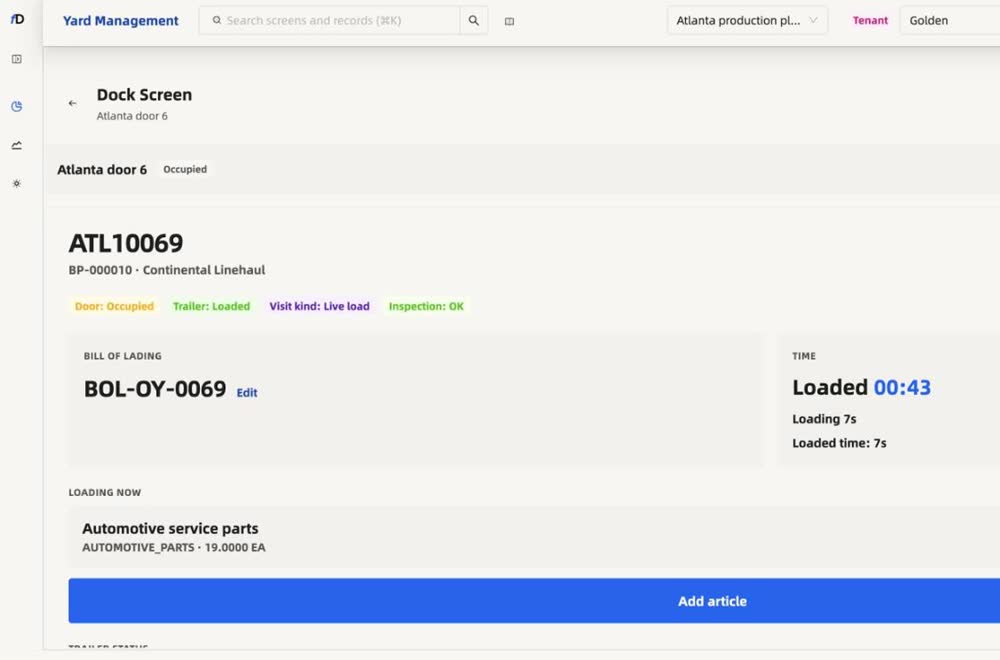
  • Same record as the gateThe finding sits on the visit next to the gate photos, so before and after can be read side by side.
Tablet · inspect before dock work

Watch it work

Real recordings from the product.

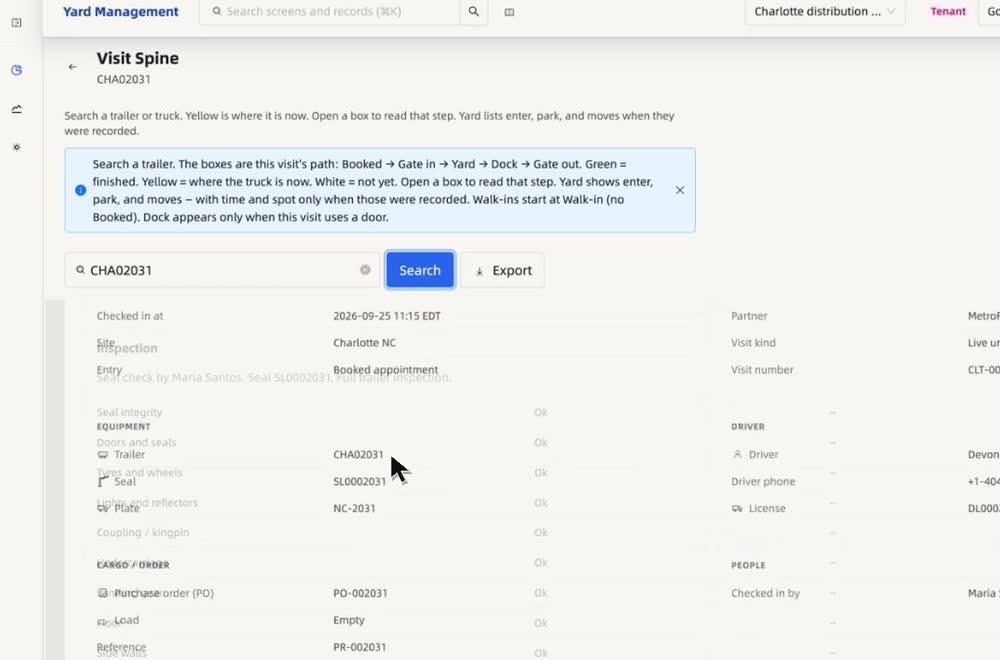
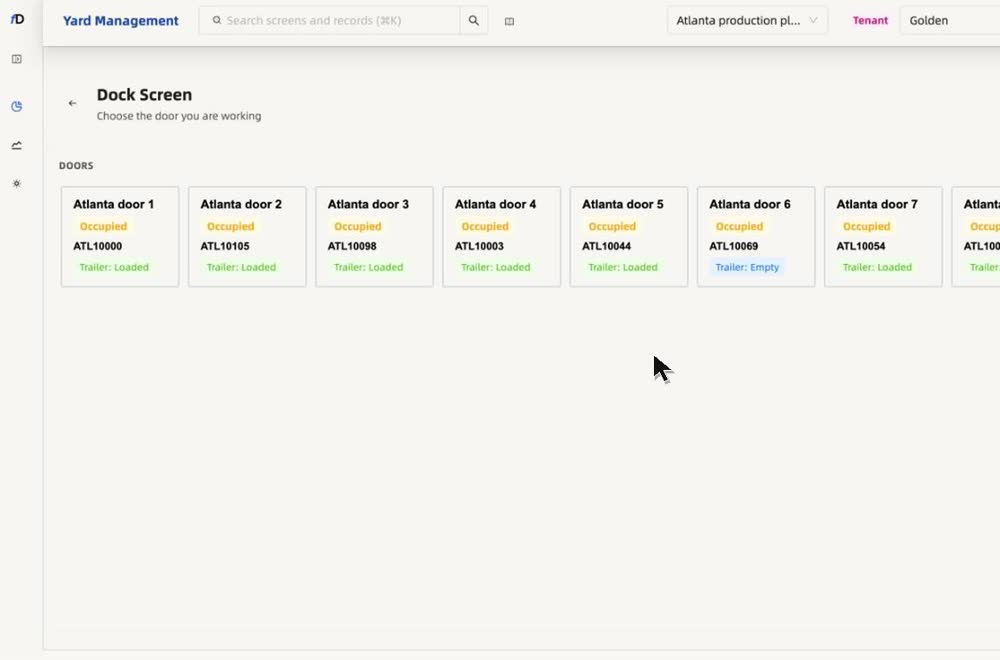
The dock screen, door by doorDoors, trailers and inspections on the dock tablet.About this video →
Yard audit and the visit spineAudit walks and the single record that follows a visit.About this video →

All product videos →

The claim you did not cause

You pay for damage you cannot prove was not yours.

Without a record from the door

  1. Day 0A $2,400 damage claim arrives for a trailer that left your dock
  2. Day 2Someone asks the dock for photos. They are on a phone, or nowhere
  3. Day 6No proof of the condition at the door, no seal number on file
  4. Day 9The claim is paid. Nobody could show it was not you

You pay $2,400 for damage you cannot disprove.

With floDock

  1. Minute 1Open the visit. The same claim, and its whole record in one place
  2. Minute 2Arrival photos from the gate walk-around, with time stamps
  3. Minute 3Load proof: seal, doors open, packing slip, count and the empty trailer
  4. Minute 4Send the file to the carrier or the customer. The claim is settled on evidence

The evidence answers the claim. You pay only what is yours.

The TCompanies survey is from 2018 and covers container and trailer damage in the United States. The claim amount above is an example, not a quoted figure.

Proof that settles claims

Loading, unloading, delivery. Every claim meets the record.

Visit ATL-001103Loading · Door 4
Evidence file
  1. ✓Seal checkedSL-77310 matches the booking
  2. ✓Doors open photoEmpty trailer, before loading
  3. ✓Count against the bill24 of 24 pallets loaded
  4. ✓Loaded photoDoors closed, seal applied
  5. •Time takenLoading took 38 minutes
Proof saved on the visitCounts, photos and times are kept in order.
Visit ATL-001097Unloading · Door 2
Evidence file
  1. ✓Seal on arrivalIntact, matches the bill
  2. ✓Doors open photoLoad as it arrived
  3. !Count against the bill22 of 24 pallets, 2 short
  4. !ConditionNeeds attention: panel dent, photo taken
  5. •Time takenUnloading took 26 minutes
Shortage recorded at the doorShare a secure evidence link with the carrier, photos included.
Trip T-5521Delivered · Customer dock
Evidence file
  1. ✓Tapped on the phone at14:42
  2. ✓Distance from destination12 m, allowed distance 150 m
  3. ✓Photos3 photos, none late
  4. ✓Receiver reasonNone needed, full delivery
  5. •ReceiptPDF ready to share
Inside the delivery radiusTime, place and photos are on the trip.
Claim C-22082 pallets short · damaged panel
Evidence file
  1. ✓Seal at gate inIntact on arrival, SL-77310
  2. ✓Count when loaded24 of 24 pallets, photo
  3. ✓Condition at the doorPanel undamaged, photo
  4. ✓Delivery proofFull delivery, inside the radius
Claim answered with the recordCounts, photos and times show the load left complete.

Every load leaves with its proof.

Seal, doors, count and photos are captured at the door and stamped with the time, the place and the device. The clock runs from loading to loaded.

yard.flodock.com

What arrived is on record before it is argued.

On arrival the seal, the doors, the count and the condition are checked against the papers. Anything short or damaged is written down with a photo, while the truck is still at the door.

yard.flodock.com

Delivered means delivered, and where.

When the driver taps Delivered, floDock keeps the time, the GPS position and its accuracy, the distance from the destination against the allowed distance, the photos and a receipt. A wrong tap is corrected, and the original stays on record.

12 mfrom the destination
150 mallowed distance
1 tapto the receipt

A claim meets the record, not a memory.

When a deduction or a damage claim arrives, open the visit. A claim the record disproves is answered with the proof. A claim the record supports is settled quickly, with a secure evidence link to the other side.

yard.flodock.com

What it is worth

The value to your business.

↑

You know the condition on arrival

Damage is on record before the truck enters your yard.

↓

Claims settled on evidence

A timestamped photo ends the argument with carriers and shippers.

↓

Problems stopped at the gate

A leaking or unsafe truck never reaches your docks.

↑

Chain of custody

Daily seal audits show which day a seal changed.

What not knowing costs

Without a record, every gate is a gamble.

$15.1B

lost to detention in one year

US for-hire trucking, 2023: $3.6B in direct costs and $11.5B in lost productivity. 39.3% of all stops had detention, adding up to more than 135 million hours.

Source: ATRI, Sept 2024
25%

of thefts are fictitious pickups

In Q3 2026, 138 of 547 thefts were fake pickups, up from 18% a year earlier. 19 thefts were worth $1M or more, and warehouses and distribution centers were the most targeted places.

Source: Verisk CargoNet, Nov 2026
3%

of cost of goods fined for a miss

Walmart's on-time, in-full rule sets a 98% target and fines misses at 3% of the cost of goods. A shipment you cannot prove is a shipment you can be fined for.

Source: Talk Business & Politics, Sept 2020

Real cases: the booking was right, the person who showed up was not

$12M

An alleged theft scheme took over real carriers' identities, booked loads from brokers, and had drivers collect them at distribution centers. At least 24 shipments never arrived.

FreightWaves, Oct 22, 2026
$10.1M

From March 2020 to September 2023, one person posed as staff at real and fictitious carriers and brokers, won loads, then redirected real drivers to warehouses he controlled. About 90 shipments, mostly liquor and copper. Five years in federal prison and $10.3M restitution.

Transport Topics
$4.5M

Eight people were indicted in Manhattan for cloning real licensed carriers' identities from public FMCSA data. The fake carriers passed screening because they resolved to active authorities, then took freight that never arrived.

LeadingIT on the June 2026 indictment
$1M+

Santo Tequila lost 24,000 bottles. Thieves made fake carrier profiles, bid on the job, hired real drivers online and redirected them from the Pennsylvania warehouse to Los Angeles. About 11,000 bottles were recovered.

CBS News, Oct 2025
Clean on paper

TAPA Americas warned of "trojan drivers": operatives hired by vetted carriers, who park at a staged break while the crew takes a high-value load. Carrier credentials and background checks come back clean.

Heavy Duty Trucking, Apr 23, 2026
$140,000

A legitimate carrier passed every check, then its email was hacked. Thieves sent a different truck to pick up a frozen-meat load. It was recovered, mishandled, refused, and became a claim.

FreightWaves, Apr 9, 2026

The driver arrival pass

The booking sends the driver a one-time QR. No pass, no entry.

Your yard decides how strict to be: off, optional, or required. The gate refuses a missing, wrong, used or replaced pass, and a supervisor can admit with a reason that is saved.

  1. 1

    Book

    The carrier enters the driver's name, phone and e-mail.

  2. 2

    Pass sent

    One pass for that driver and that visit, by e-mail: an 8-character code and a QR.

  3. 3

    Driver arrives

    Shows the code or QR, from the e-mail or the Partner app.

  4. 4

    Gate checks

    The clerk scans or types it. An optional ID check compares the driver's name.

  5. 5

    Used once

    The pass is used up and the check-in is logged. A copy cannot get a second truck in.

9:41

Your arrival pass

Show this code to the guard at the gate.

AcceptedCheck-in logged

Riley Chen

Valid until Mon, Nov 9, 2:00 PM

No signal? The guard can also type the code from your e-mail.

In the Partner app: the pass on the driver's Home tab, ready for the gate scan.
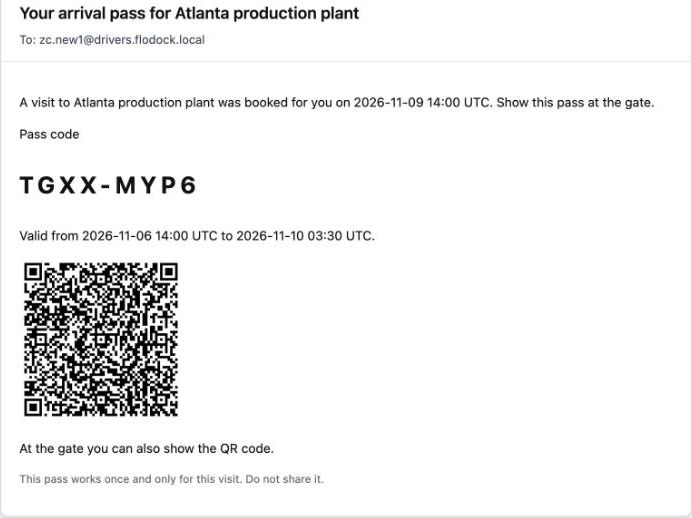
The e-mail a driver receives: pass code, validity window and QR code
What the driver gets: the code, the window it is valid in, and the QR.
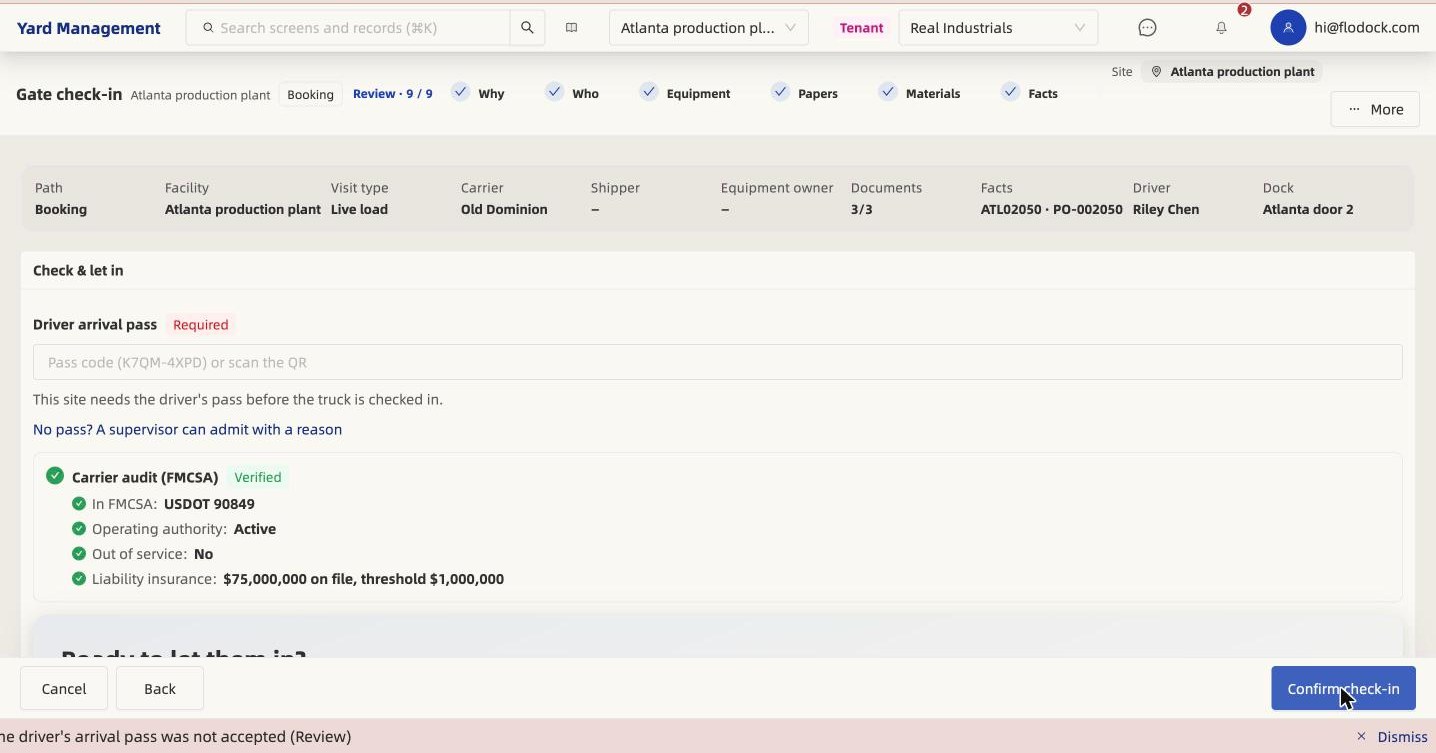
Gate check-in review step with a required driver arrival pass box and a refusal message
At the gate: no accepted pass, no check-in. The carrier audit from FMCSA sits right beside it.
Wrong code five times locks it for 15 minutesDriver changed? The booker resends and the old QR stops workingEvery send, scan, refusal and override is in the log

At the gate: who showed up?

The booking says one thing. The gate checks the rest.

BookedArrived
CarrierPeachtree FreightPeachtree FreightMatch
TrailerTRL3305TRL3305Match
DriverOn the bookingDifferent personHold
Tractor plateOn the bookingNot on fileHold

A mismatch is flagged before the trailer moves, and the driver, plate and trailer photos are saved with the visit.

On the dock: how long did it really take?

Every minute on site has a timestamp.

Gate in08:02
At the door08:4139 min waiting for a door
Loading starts08:50
Loaded10:121 h 22 min loading
Gate out10:312 h 29 min on site

For a 3PL, this is the answer to "who held the truck?" when a detention bill or a customer complaint arrives.

Detention, with proof

Waiting time becomes a number you can defend.

GeneralFreight & documentsDwell & chargesDocuments

Free time, tier breakdown, and accrued charges for this visit. Policy comes from site rules and any partner overlay.

StatusFree time
Elapsed units0
Free units remaining3
Chargeable units0
Accrued total0.00 USD

Tier breakdown

StepFromToUnitsRateAmount
1120100.000.00
Gate-out. The charge is locked at 200.00 USD and does not change afterwards.

Free time, tiers and supervisor adjustments are all on the visit. At gate-out the charge locks, so the invoice cannot drift.

At the gate: no retyping

A photo of the bill of lading fills in the fields.

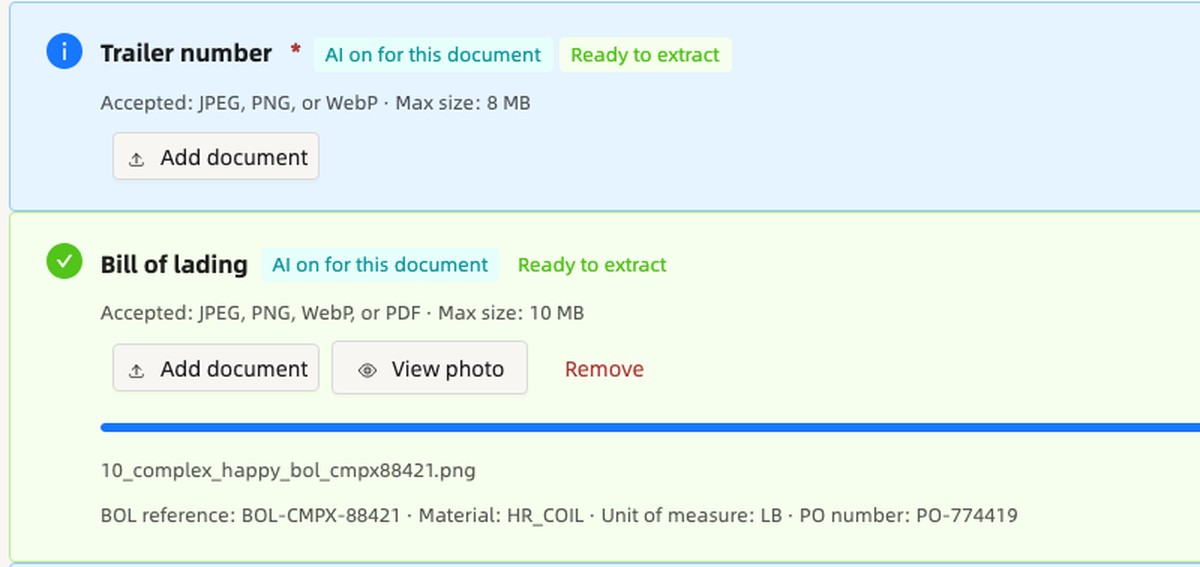
Gate check-in papers step: bill of lading uploaded, with the reference, material, unit and PO number read from the photo

The BOL reference, material, unit and PO number come from the photo. Trailer number and licence plate can be read the same way.

Put your own numbers in

What a missing record could cost your yard.

Change the inputs. The sums are shown, and the assumptions are yours.

Detention exposure a year$0
Claims and chargebacks a year$0
At your assumed share, a year$0Exposure x your share

Regional distribution centers and 3PLs

When you run the yard for someone else's freight, the inspection is your defence.

A third-party logistics provider answers to its customers for freight it did not make and carriers it did not pick. Inspections turn "we think it arrived that way" into a dated record.

01

Settle customer disputes in minutes

When a customer says damage happened on your site, the dated gate and dock findings answer it. Share the record as a secure, read-only link, with the inspection section ticked, instead of reconstructing it from memory.

02

Show who had the trailer, and when

Gate-in, inspection, dock work and gate-out sit on one visit. Every hand-off between shifts and between teams is on the record.

03

Push claims back where they belong

A trailer marked damaged at arrival, with photos, is a carrier's claim, not yours. Share that evidence with the carrier as a secure link, and stop absorbing the cost.

04

Hold every site to one standard

Every door and every shift uses the same screens, so a regional network is inspected the same way in every building.

05

Seals checked on a schedule

Daily seal audits give chain of custody. If a seal changed, you can see which day it changed.

06

Be ready for the customer review

Service reviews and audits ask for evidence. The inspection history of a visit is already there, with times, people and photos.

Without inspections on the record

  • A customer reports damaged freight days later
  • Different sites inspect in different ways
  • Findings live on paper, in texts and in photos on phones
  • Nobody can say if damage came with the truck
  • Audit prep means chasing people

With floDock

  • Photos, notes and times from arrival and from the dock, on the visit
  • The same guided check at every gate and door
  • One record per visit that anyone with access can open
  • A dated comparison of before and after the dock work
  • Search the visit and read the history

What it does

Built around the visit.

  • Gate inspections on arrival and departure
  • Dock inspections before loading and unloading
  • Yard audit walks with findings per spot
  • Trailer condition with photos, tied to the visit
  • Findings feed the same record as load proof
01

Walk

Follow a checklist on the phone or tablet.

02

Capture

Photos and notes attach to the visit and spot.

03

Review

Managers see open findings across sites.

In depth

Inspections, and why dated damage matters.

What is covered

Five kinds of inspection on one record

Inspections happen where the work happens, and all of them attach to the same visit, so a finding at the gate and a finding at the dock can be read together.

InspectionWhenWhat it gives you
Gate inspectionOn arrival and on departureThe condition of the truck and trailer before it enters, and as it leaves
Dock inspectionBefore and after loading or unloadingA dated comparison of the trailer and freight around your dock work
Yard audit walkOn a schedule you setFindings per spot, so problems are found before a driver finds them
Trailer conditionWhenever it mattersPhotos and notes tied to the visit and the trailer
Driver trailer reportFrom the driver's phone, where your yard turns it onA checklist with marks, reasons and photos, sent from the Go app and saved offline until there is signal

Why it matters

Damage that is dated is damage you can place

A photo with a time stamp, taken at the gate, tells you whether damage arrived with the truck or happened on your site. That is the difference between absorbing a claim and answering it.

Daily seal audits add chain of custody: if a seal changed, you can see which day.

At the door

How an inspection runs

The person at the gate or dock opens the visit and is taken through the check one area at a time.

  1. 1
    Open the visitThe trailer, carrier and booking are already on screen, so nothing is typed twice.
  2. 2
    Mark each areaFloor, side walls, roof and more: Good, Damaged or Wrong, one tap each.
  3. 3
    Add photos and a reasonWhere something is not right, a photo and a reason are attached to that finding.
  4. 4
    Set the overall conditionOK, Needs attention or Damaged, plus in service or out of service for the trailer.
  5. 5
    Carry on with the workThe finding is saved on the visit with the time and the person, before dock work begins.

Regional distribution centers

Why inspections matter most in 3PL-run buildings

A regional distribution center run by a third-party logistics provider handles freight for several customers, moved by carriers the customer often chose. When damage appears, three parties each have a reason to say it was someone else's. The party with the dated record wins that conversation.

Inspections give the 3PL that record at the two moments that matter: when the trailer arrives and when dock work starts or ends. Doing it the same way on every door and every shift also means a customer reviewing a regional network sees one standard, not one per building.

  • Damage that arrived with the truck is answered with arrival photos and times, and goes back to the carrier.
  • Damage that happened on site is found the same day, while it can still be fixed and explained.
  • Seal audits show when a seal changed, which is the question every cargo-loss review starts with.
  • Shift hand-offs are on the record, so the next team knows what the last team saw.
  • Customer service reviews can be answered from the record rather than from memory.

A practical standard

What a good inspection standard covers

floDock does not set your standard; your company does. A common approach for a busy site is:

  • Every arrival is checked at the gate, with the same short list for every truck.
  • Every load is checked at the door before work starts, and again when it ends.
  • Seals are audited daily for trailers that stay on the yard.
  • Anything marked Damaged or Needs attention carries a photo and a reason.
  • Findings are reviewed by a supervisor, not only filed.
Questions

Straight answers, in full.

Which inspections are there?

Gate inspections on arrival and departure, dock inspections before loading and unloading, yard audit walks with findings per spot, and trailer condition with photos.

Can we change the checklists?

Checklists are set per site with our team during onboarding.

How do inspections help with claims?

Damage is dated before it becomes a dispute. A time-stamped photo from the gate or the dock shows what the trailer looked like and when.

What about seals?

Seal numbers are recorded at gate in, in the yard and at exit, and daily seal audits show which day a seal changed.

See it on your own yard.

Talk to our team and we will walk through your gates, doors and carriers.

Talk to our team