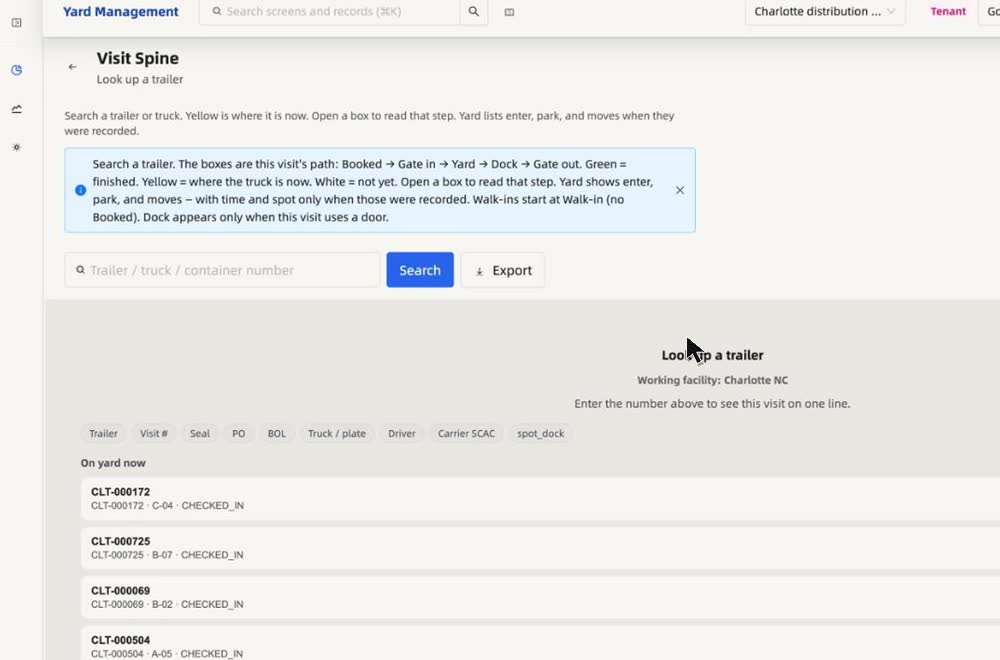
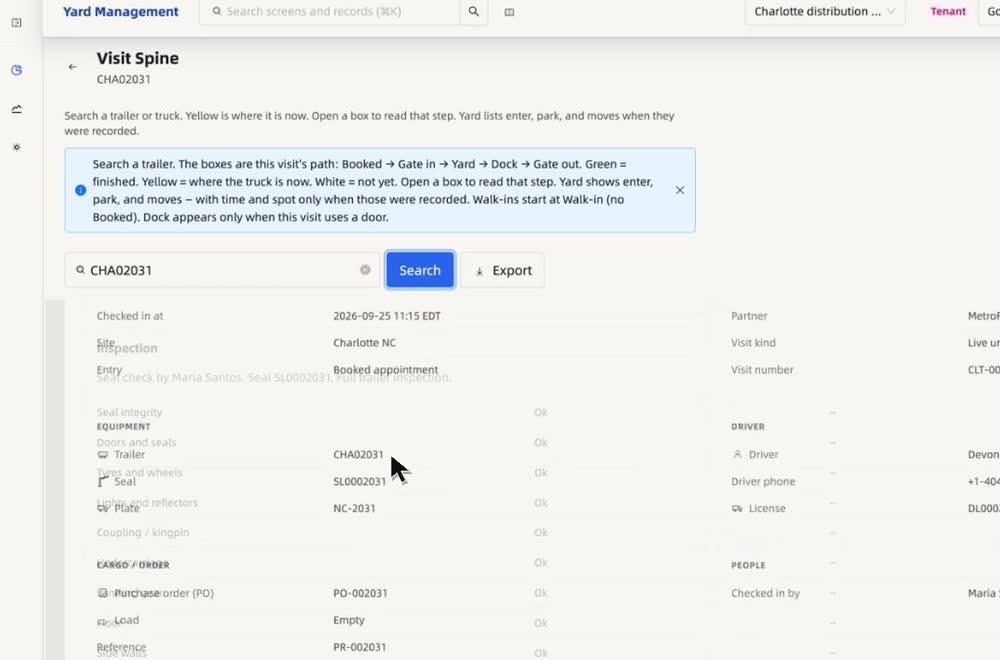
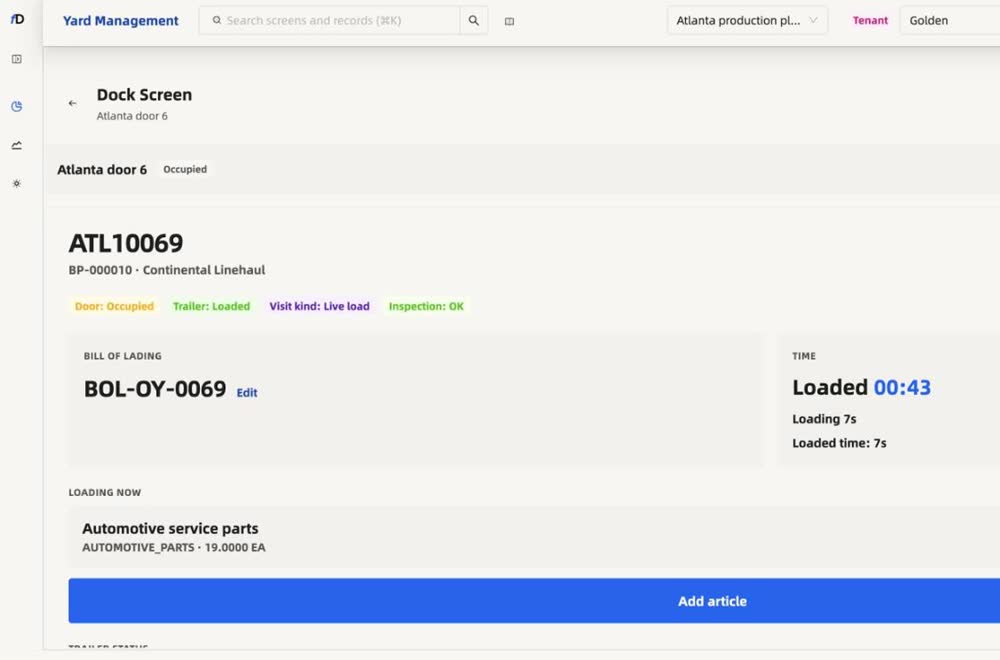
- ✓Seal checkedSL-77310 matches the booking
- ✓Doors open photoEmpty trailer, before loading
- ✓Count against the bill24 of 24 pallets loaded
- ✓Loaded photoDoors closed, seal applied
- •Time takenLoading took 38 minutes
Claims with evidence
Settle it on evidence, not argument.
Everything a claim needs is already on the visit: arrival photos, seal numbers, load proof, time stamps and dwell charges. Put the claim together from it and share it as a secure, read-only evidence link with the carrier or customer.


The claim you did not cause
You pay for damage you cannot prove was not yours.
- 39%of carriers were asked to pay for trailer or container damage they did not causeTCompanies survey, FreightWaves, Nov 2018
- 61%of those paid anyway, because they could not prove it was not themSame survey: 61% could not prove they were not responsible
- 20 to 30%of retailer deductions get disputed. Suppliers win back about 40% of thoseSPS Commerce, The Supply Chain Source, Nov 2025
- Up to 13%of a retail account's revenue went to chargebacks in one Gartner surveySupplyChainBrain, Dec 2017, citing Gartner
×Without a record from the door
- Day 0A $2,400 damage claim arrives for a trailer that left your dock
- Day 2Someone asks the dock for photos. They are on a phone, or nowhere
- Day 6No proof of the condition at the door, no seal number on file
- Day 9The claim is paid. Nobody could show it was not you
You pay $2,400 for damage you cannot disprove.
✓With floDock
- Minute 1Open the visit. The same claim, and its whole record in one place
- Minute 2Arrival photos from the gate walk-around, with time stamps
- Minute 3Load proof: seal, doors open, packing slip, count and the empty trailer
- Minute 4Send the file to the carrier or the customer. The claim is settled on evidence
The evidence answers the claim. You pay only what is yours.
The TCompanies survey is from 2018 and covers container and trailer damage in the United States. The claim amount above is an example, not a quoted figure.
Proof that settles claims
Loading, unloading, delivery. Every claim meets the record.
- ✓Seal on arrivalIntact, matches the bill
- ✓Doors open photoLoad as it arrived
- !Count against the bill22 of 24 pallets, 2 short
- !ConditionNeeds attention: panel dent, photo taken
- •Time takenUnloading took 26 minutes
- ✓Tapped on the phone at14:42
- ✓Distance from destination12 m, allowed distance 150 m
- ✓Photos3 photos, none late
- ✓Receiver reasonNone needed, full delivery
- •ReceiptPDF ready to share
- ✓Seal at gate inIntact on arrival, SL-77310
- ✓Count when loaded24 of 24 pallets, photo
- ✓Condition at the doorPanel undamaged, photo
- ✓Delivery proofFull delivery, inside the radius
Every load leaves with its proof.
Seal, doors, count and photos are captured at the door and stamped with the time, the place and the device. The clock runs from loading to loaded.

What arrived is on record before it is argued.
On arrival the seal, the doors, the count and the condition are checked against the papers. Anything short or damaged is written down with a photo, while the truck is still at the door.

Delivered means delivered, and where.
When the driver taps Delivered, floDock keeps the time, the GPS position and its accuracy, the distance from the destination against the allowed distance, the photos and a receipt. A wrong tap is corrected, and the original stays on record.
A claim meets the record, not a memory.
When a deduction or a damage claim arrives, open the visit. A claim the record disproves is answered with the proof. A claim the record supports is settled quickly, with a secure evidence link to the other side.

What it is worth
The value to your business.
Claims settled on evidence
A timestamped photo ends the argument.
Accountability to the right party
Patterns by carrier, and proof if you end the relationship.
Dwell charges recovered
Charges are worked out for you and kept in a history.
What not knowing costs
Without a record, every gate is a gamble.
lost to detention in one year
US for-hire trucking, 2023: $3.6B in direct costs and $11.5B in lost productivity. 39.3% of all stops had detention, adding up to more than 135 million hours.
Source: ATRI, Sept 2024stolen from freight in 2025
2,646 confirmed cargo thefts in the US and Canada, up 18%. Losses were up 60%, and the average theft was worth $273,990.
Source: CargoNet via Work Truck Online, Jan 2026of thefts are fictitious pickups
In Q3 2026, 138 of 547 thefts were fake pickups, up from 18% a year earlier. 19 thefts were worth $1M or more, and warehouses and distribution centers were the most targeted places.
Source: Verisk CargoNet, Nov 2026of cost of goods fined for a miss
Walmart's on-time, in-full rule sets a 98% target and fines misses at 3% of the cost of goods. A shipment you cannot prove is a shipment you can be fined for.
Source: Talk Business & Politics, Sept 2020Real cases: the booking was right, the person who showed up was not
An alleged theft scheme took over real carriers' identities, booked loads from brokers, and had drivers collect them at distribution centers. At least 24 shipments never arrived.
FreightWaves, Oct 22, 2026From March 2020 to September 2023, one person posed as staff at real and fictitious carriers and brokers, won loads, then redirected real drivers to warehouses he controlled. About 90 shipments, mostly liquor and copper. Five years in federal prison and $10.3M restitution.
Transport TopicsEight people were indicted in Manhattan for cloning real licensed carriers' identities from public FMCSA data. The fake carriers passed screening because they resolved to active authorities, then took freight that never arrived.
LeadingIT on the June 2026 indictmentSanto Tequila lost 24,000 bottles. Thieves made fake carrier profiles, bid on the job, hired real drivers online and redirected them from the Pennsylvania warehouse to Los Angeles. About 11,000 bottles were recovered.
CBS News, Oct 2025TAPA Americas warned of "trojan drivers": operatives hired by vetted carriers, who park at a staged break while the crew takes a high-value load. Carrier credentials and background checks come back clean.
Heavy Duty Trucking, Apr 23, 2026A legitimate carrier passed every check, then its email was hacked. Thieves sent a different truck to pick up a frozen-meat load. It was recovered, mishandled, refused, and became a claim.
FreightWaves, Apr 9, 2026How floDock answers
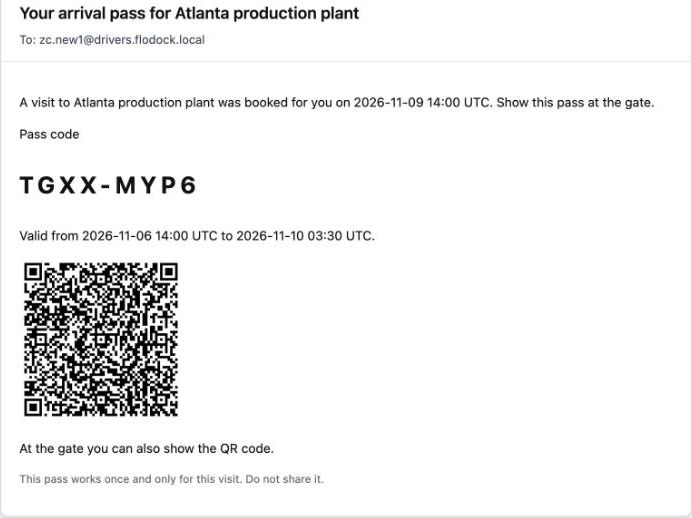
The driver arrival pass
The booking sends the driver a one-time QR. No pass, no entry.
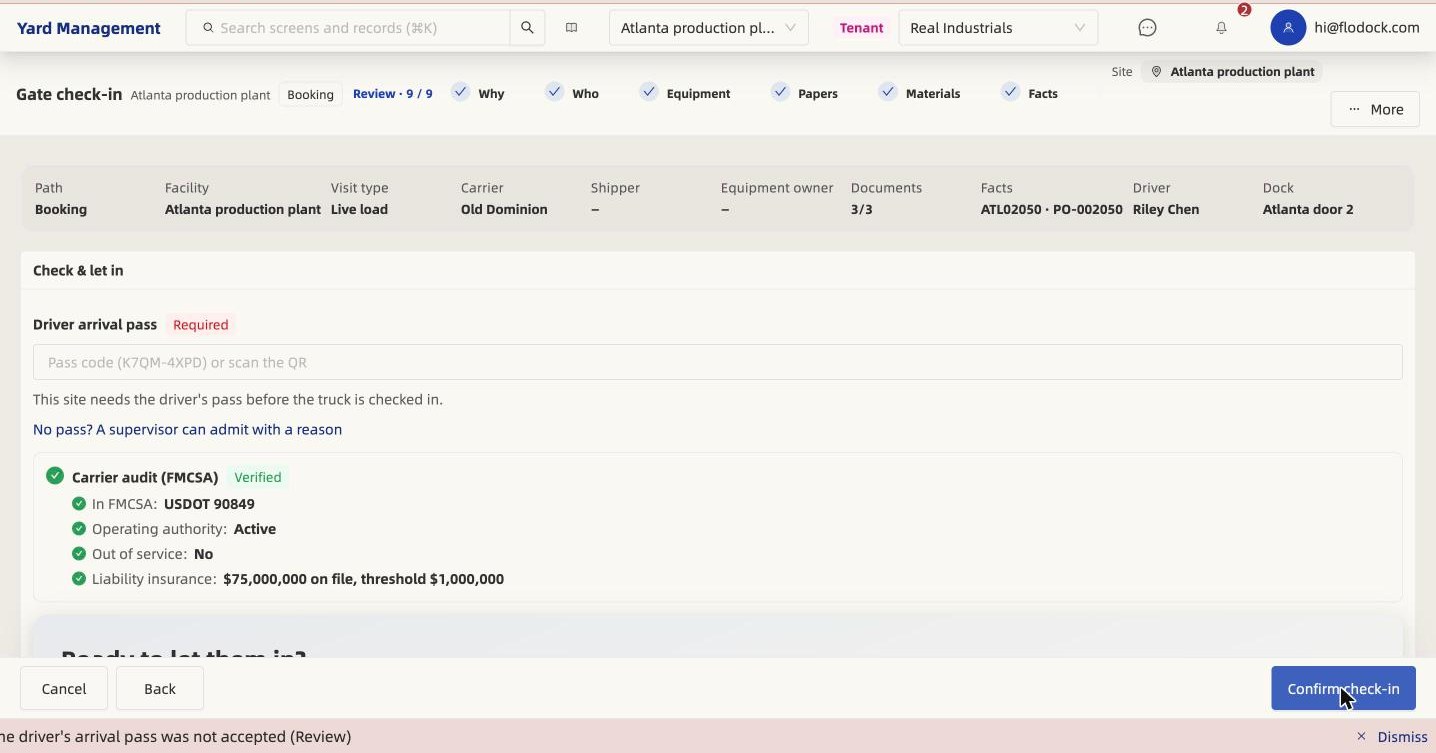
Your yard decides how strict to be: off, optional, or required. The gate refuses a missing, wrong, used or replaced pass, and a supervisor can admit with a reason that is saved.
- 1
Book
The carrier enters the driver's name, phone and e-mail.
- 2
Pass sent
One pass for that driver and that visit, by e-mail: an 8-character code and a QR.
- 3
Driver arrives
Shows the code or QR, from the e-mail or the Partner app.
- 4
Gate checks
The clerk scans or types it. An optional ID check compares the driver's name.
- 5
Used once
The pass is used up and the check-in is logged. A copy cannot get a second truck in.
Your arrival pass
Show this code to the guard at the gate.
Riley Chen
Valid until Mon, Nov 9, 2:00 PM
No signal? The guard can also type the code from your e-mail.


At the gate: who showed up?
The booking says one thing. The gate checks the rest.
A mismatch is flagged before the trailer moves, and the driver, plate and trailer photos are saved with the visit.
On the dock: how long did it really take?
Every minute on site has a timestamp.
For a 3PL, this is the answer to "who held the truck?" when a detention bill or a customer complaint arrives.
Detention, with proof
Waiting time becomes a number you can defend.
Free time, tier breakdown, and accrued charges for this visit. Policy comes from site rules and any partner overlay.
Tier breakdown
Free time, tiers and supervisor adjustments are all on the visit. At gate-out the charge locks, so the invoice cannot drift.
At the gate: no retyping
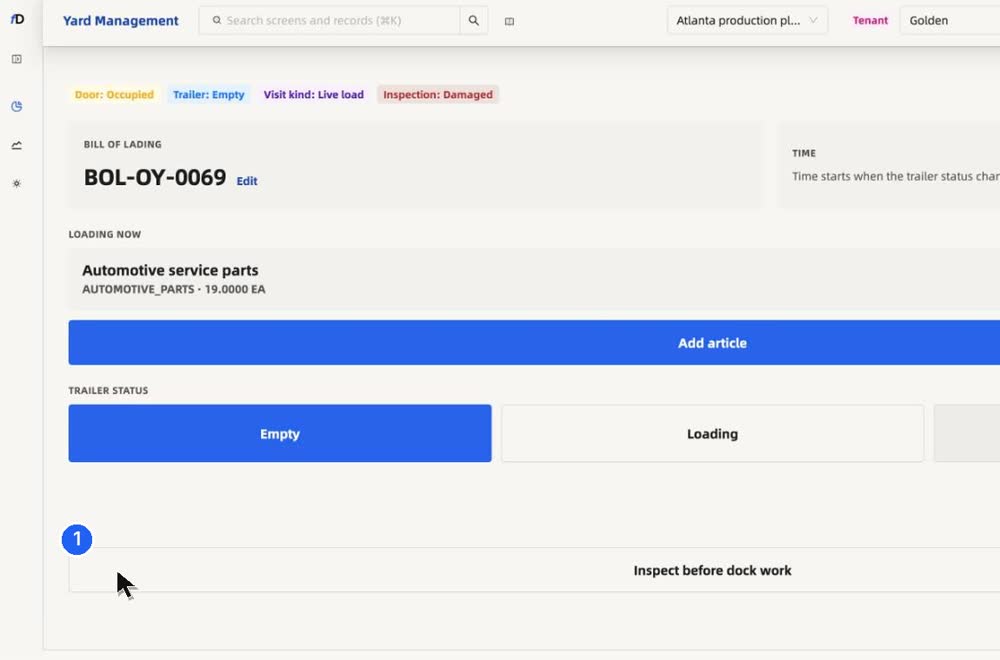
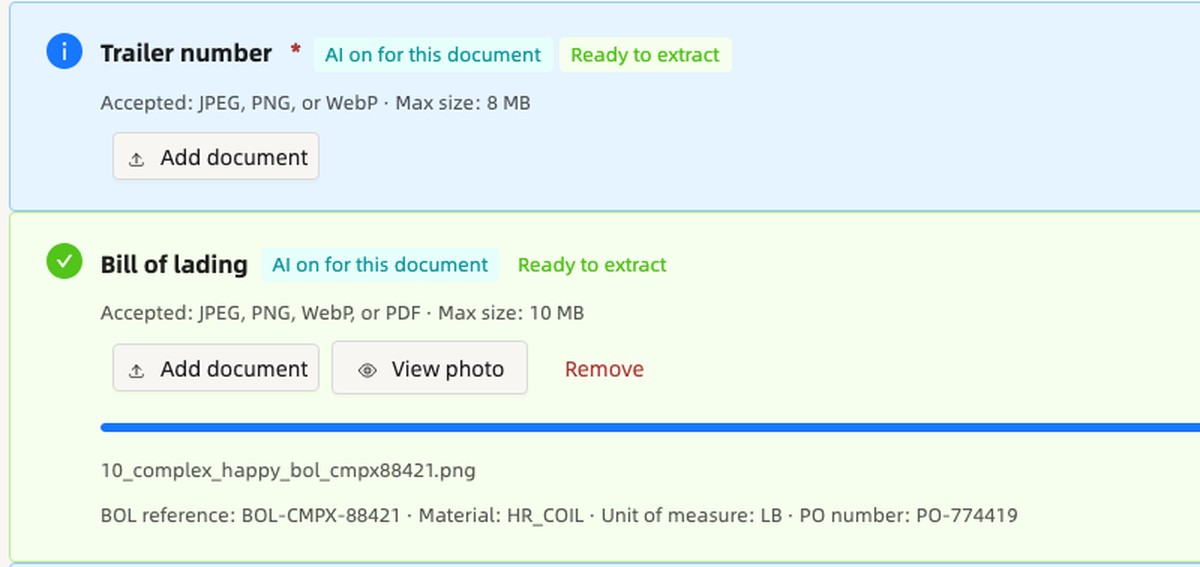
A photo of the bill of lading fills in the fields.

The BOL reference, material, unit and PO number come from the photo. Trailer number and licence plate can be read the same way.
Put your own numbers in
What a missing record could cost your yard.
Change the inputs. The sums are shown, and the assumptions are yours.
What it does
Built around the visit.
- Arrival condition photos from the gate walkaround
- Seal numbers at gate-in, in the yard and at exit
- Load proof: count, photo and seal against the BOL
- Dwell and detention charges calculated per trailer
- A secure evidence link, protected by a one-time e-mail code
Collect
Evidence builds up on the visit as work happens.
Assemble
Pick the visit and the issue. The evidence is already there.
Share
Send a secure, read-only evidence link to the carrier or customer, and see when it is opened.
In depth
How a claim is built from the visit record.
The basics
What a freight claim needs to hold up
A claim is settled on what each side can show. The side with a dated, specific record usually has the easier conversation. The party that cannot show what happened tends to pay, which is why so many carriers settle damage they did not cause.
A strong claim file answers five questions: what arrived, what was loaded or unloaded, what the seal said, how long the truck waited, and who handled it. floDock records each of those on the visit as the work happens.
The evidence
Where each piece of evidence comes from
Nothing is collected for the claim afterwards. The claim is put together from records that already exist on the visit.
| Evidence | Captured when | Where it lives |
|---|---|---|
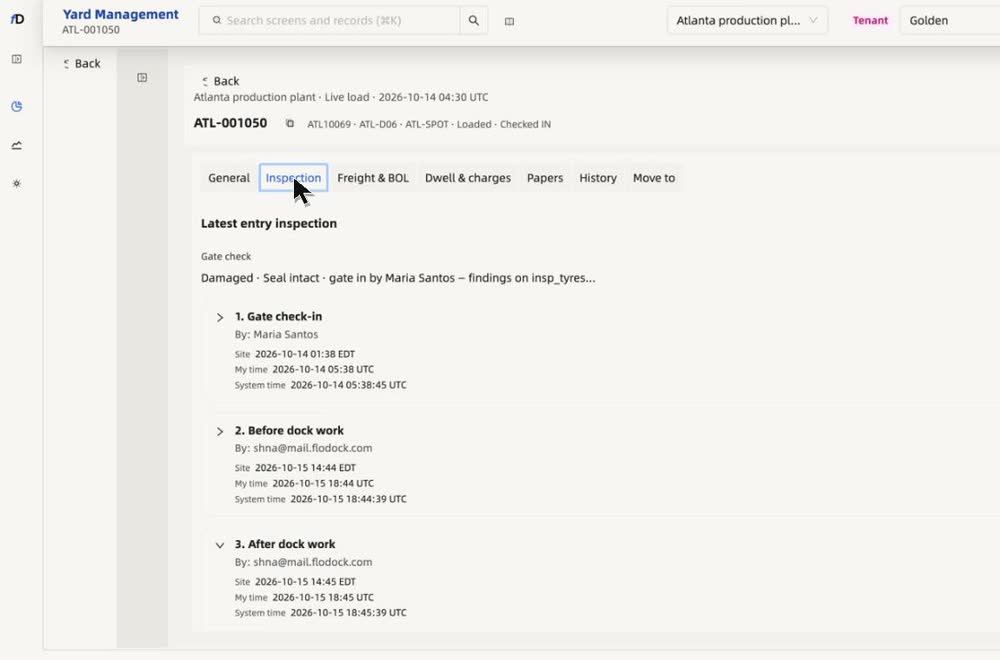
| Arrival condition photos | At gate-in, during the walkaround | The gate inspection on the visit |
| Seal numbers | At gate-in, in the yard and at exit | The visit record and daily seal audits |
| Load proof: count, photos and seal against the bill of lading | At the dock door | The load proof record on the visit |
| Time stamps | At every status change | The visit history |
| Dwell and detention charges | Worked out from free time and tiers, frozen at gate-out | The Dwell and charges tab |
| Messages and documents | When requested and received | The visit's communications |
Claim types
The claims a visit record helps you answer
Different claims lean on different parts of the record. Having all of it on one visit means you do not have to know in advance which one you will need.
- Damage claims: arrival photos and before and after dock photos show when the damage appeared.
- Shortage and overage claims: the count against the bill of lading, taken at the door.
- Seal and tampering questions: seal numbers recorded at gate-in, in the yard and at exit.
- Detention and demurrage disputes: arrival, door and gate-out times with the charge worked out from your rules.
- Retailer chargebacks and deductions: the load proof and time stamps for the shipment in question.
- Cargo theft and fictitious pickups: who was admitted, with the pass, the photos and any supervisor override and its reason.
The file
Open the claim and answer it
A claim is a case with a number. You record which side you are on (you are claiming, or a claim has been made against you), who the counterparty is, and the visit, bill of lading, freight line, dock exception or trip it concerns. Your company can set up claim types, each one pre-filling the sections to share, a cover note, how long the link lasts and who it goes to.
- 1CollectEvidence builds up on the visit as work happens.
- 2Open the claimChoose the visit and the issue. Nothing is retyped.
- 3Choose what to shareTick the sections, and set how names and locations appear.
- 4Share the linkThe carrier or customer receives a secure link by e-mail.
- 5Follow itSee when it was invited, opened and viewed. The claim moves from Open to Evidence sent, Responded and Closed.
Sharing
The secure evidence link, and what you control
The link opens a read-only page for one record. It is built once, at the moment you share, and does not change afterwards, so both sides look at the same thing. Each part of it is a choice your company makes.
- Wrong codes lock the recipient out, and you are told.
- Every step is logged and the log can be exported: invited, code requested, opened, viewed, downloaded.
- You get a notice at the first view, a reminder before a link expires and a reminder when nobody has opened it.
- Your company sets the limits, and a site can narrow them for itself.
| Control | Options | Why it matters |
|---|---|---|
| Which record | The loading record for a customer, or the unloading record for a supplier or vendor | Both directions of a claim are covered |
| Sections | Summary, counts, seals, photos and video, capture times, location, who captured, inspection, gate records, documents, plus delivery outcome, or arrival condition, pallet marks and weights | Share what answers the claim and nothing else; what is not ticked is not in the record |
| How the recipient gets in | A one-time code sent to the invited e-mail address, or link-only where your company allows it | The link alone does not open the record |
| Who captured | Name, role only, or hidden | Protects drivers and staff |
| Location | Exact, exact near your site and rounded away from it, rounded, or none | Shows the place without exposing routes |
| Time and reach | Expiry date, extend or withdraw at any time, view limits, download on or off, watermark | You decide how long and how widely it is open |
| Colleagues | Off, ask first, or allowed for the same company | A claims team can bring in a colleague without you re-sending |
Time
Proving time: dwell and detention
Detention disputes are arguments about minutes. floDock counts free units, applies your tiers and shows the units, rate and amount per step. The charge is locked at gate-out and does not change afterwards, so the number you send is the number on the record.
Retention
Keeping the record
Your company controls how long visit records and photos are kept. floDock processes them on your instructions, as described in the privacy notice and the data processing addendum.
Questions
Straight answers, in full.
Where can a claim be sent?
A claim is opened from the visit and answered with a secure evidence link sent to the carrier or to the customer. The link shows the photos, seals, load proof, time stamps and other sections you choose.
What if the damage was already on the trailer when it arrived?
The gate walk-around records the condition on arrival with photos and a time stamp, so damage that came in with the truck is dated before it reaches your dock.
Do we have to build the evidence file by hand?
No. Evidence builds up on the visit as the work happens: arrival photos, seals at gate in, in the yard and at exit, load proof at the door, and dwell charges per trailer.
Can a customer open the proof online?
Yes. The evidence link opens a read-only page. By default the recipient asks for a one-time code, which is sent to the e-mail address you invited, and then sees the record. You can set the link to expire, withdraw it at any time, and see when it was opened.
Can we choose what the other side sees?
Yes. You tick the sections to share: summary, counts, seals, photos and video, capture times, location, who captured, inspection, gate records and documents. For a load there is also the delivery outcome. For an unload there are arrival condition, pallet marks and weights. Your company sets what is allowed. Anything not ticked is not in the record at all.
Can we hide names and exact locations?
Yes. Who captured can be shown by name, shown by role only, or hidden. Location can be exact, exact near your site and rounded away from it, rounded everywhere, or left out.
Can the record change after we send it?
No. The record is frozen at the moment you share it, so the recipient and you see the same thing. If something needs adding, you create a newer version of the share.
How do we know it was opened?
Every step is logged: invited, code requested, opened, viewed, downloaded, and a lock-out after too many wrong codes. You get a notice at the first view, and reminders when a link is about to expire or has not been opened. The log can be exported.
Does it work for deliveries into our site too?
Yes. Sharing works in both directions: the loading record for a customer, and the unloading record for a supplier or vendor.
How are claims tracked?
Each claim is a case with a number. You say whether you are claiming or a claim is against you, who the counterparty is, and which visit, bill of lading, freight line, dock exception or trip it concerns. A case moves from Open to Evidence sent, Responded and Closed.
How does this reduce chargebacks?
Most disputes come down to who can show the condition and the count at the door. With a time-stamped record you answer a deduction with the evidence rather than the argument.
Read next
Go deeper on this.
See it on your own yard.
Talk to our team and we will walk through your gates, doors and carriers.
Talk to our team