lost to detention in one year
US for-hire trucking, 2023: $3.6B in direct costs and $11.5B in lost productivity. 39.3% of all stops had detention, adding up to more than 135 million hours.
Source: ATRI, Sept 2024Cargo theft
A fictitious pickup is cargo theft by impersonation. Someone poses as the booked carrier or driver, collects a real load from a real dock, and disappears. Below: what it costs, the cases behind the numbers, and the checks that stop it at the gate.
US for-hire trucking, 2023: $3.6B in direct costs and $11.5B in lost productivity. 39.3% of all stops had detention, adding up to more than 135 million hours.
Source: ATRI, Sept 20242,646 confirmed cargo thefts in the US and Canada, up 18%. Losses were up 60%, and the average theft was worth $273,990.
Source: CargoNet via Work Truck Online, Jan 2026In Q3 2026, 138 of 547 thefts were fake pickups, up from 18% a year earlier. 19 thefts were worth $1M or more, and warehouses and distribution centers were the most targeted places.
Source: Verisk CargoNet, Nov 2026Walmart's on-time, in-full rule sets a 98% target and fines misses at 3% of the cost of goods. A shipment you cannot prove is a shipment you can be fined for.
Source: Talk Business & Politics, Sept 2020Real cases: the booking was right, the person who showed up was not
An alleged theft scheme took over real carriers' identities, booked loads from brokers, and had drivers collect them at distribution centers. At least 24 shipments never arrived.
FreightWaves, Oct 22, 2026From March 2020 to September 2023, one person posed as staff at real and fictitious carriers and brokers, won loads, then redirected real drivers to warehouses he controlled. About 90 shipments, mostly liquor and copper. Five years in federal prison and $10.3M restitution.
Transport TopicsEight people were indicted in Manhattan for cloning real licensed carriers' identities from public FMCSA data. The fake carriers passed screening because they resolved to active authorities, then took freight that never arrived.
LeadingIT on the June 2026 indictmentSanto Tequila lost 24,000 bottles. Thieves made fake carrier profiles, bid on the job, hired real drivers online and redirected them from the Pennsylvania warehouse to Los Angeles. About 11,000 bottles were recovered.
CBS News, Oct 2025TAPA Americas warned of "trojan drivers": operatives hired by vetted carriers, who park at a staged break while the crew takes a high-value load. Carrier credentials and background checks come back clean.
Heavy Duty Trucking, Apr 23, 2026A legitimate carrier passed every check, then its email was hacked. Thieves sent a different truck to pick up a frozen-meat load. It was recovered, mishandled, refused, and became a claim.
FreightWaves, Apr 9, 2026How floDock answers
The driver arrival pass
Your yard decides how strict to be: off, optional, or required. The gate refuses a missing, wrong, used or replaced pass, and a supervisor can admit with a reason that is saved.
The carrier enters the driver's name, phone and e-mail.
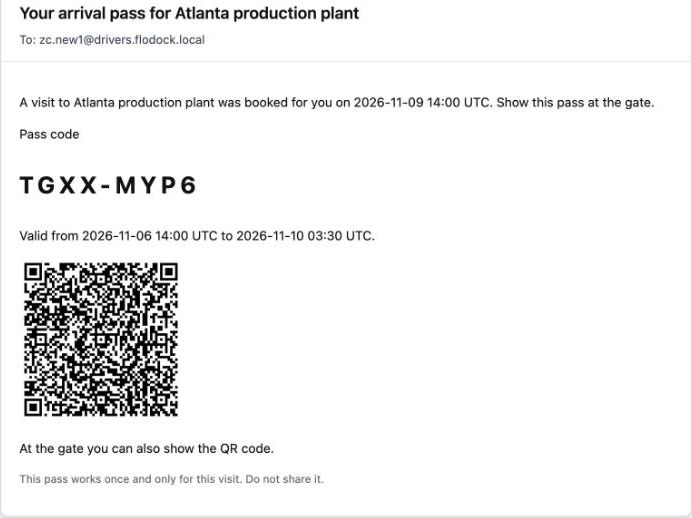
One pass for that driver and that visit, by e-mail: an 8-character code and a QR.
Shows the code or QR, from the e-mail or the Partner app.
The clerk scans or types it. An optional ID check compares the driver's name.
The pass is used up and the check-in is logged. A copy cannot get a second truck in.
Show this code to the guard at the gate.
Riley Chen
Valid until Mon, Nov 9, 2:00 PM
No signal? The guard can also type the code from your e-mail.
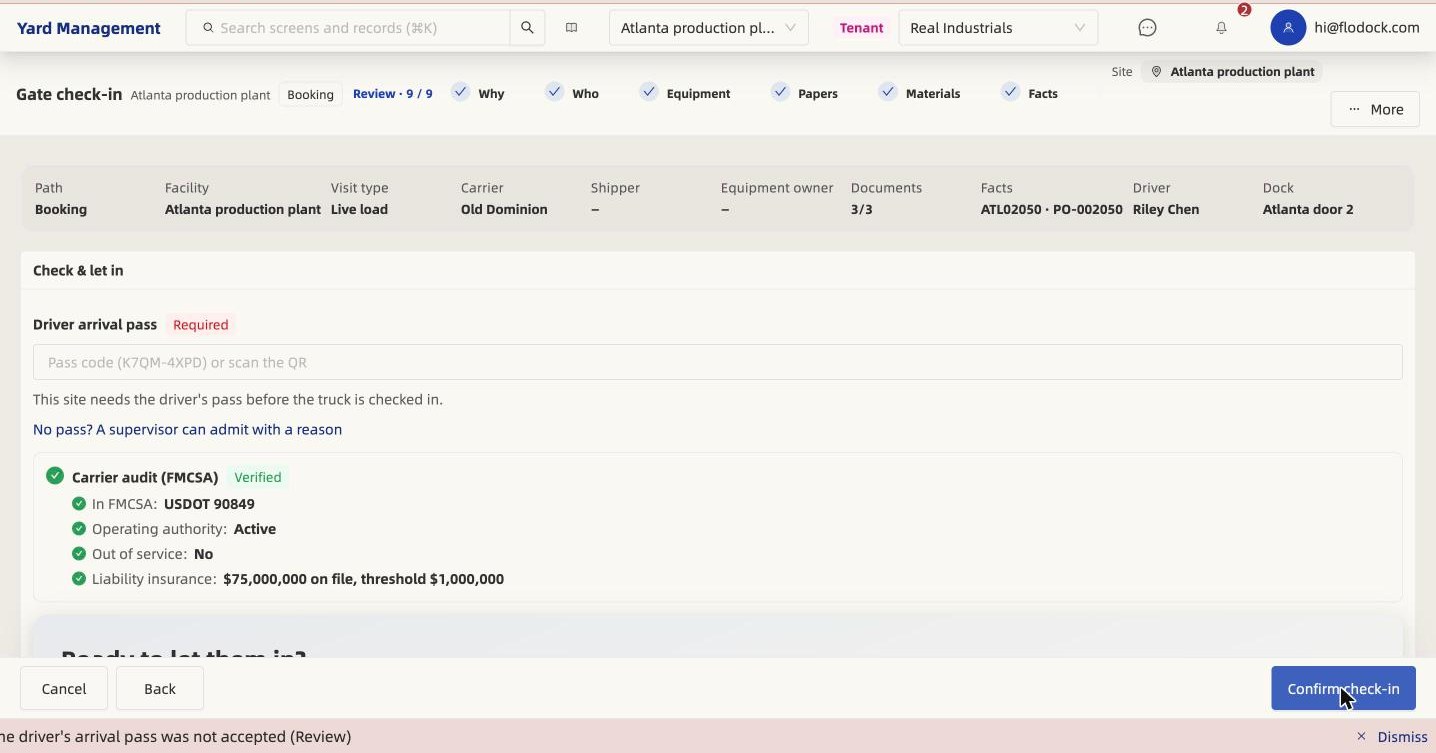
At the gate: who showed up?
A mismatch is flagged before the trailer moves, and the driver, plate and trailer photos are saved with the visit.
On the dock: how long did it really take?
For a 3PL, this is the answer to "who held the truck?" when a detention bill or a customer complaint arrives.
Detention, with proof
Free time, tier breakdown, and accrued charges for this visit. Policy comes from site rules and any partner overlay.
Tier breakdown
Free time, tiers and supervisor adjustments are all on the visit. At gate-out the charge locks, so the invoice cannot drift.
At the gate: no retyping
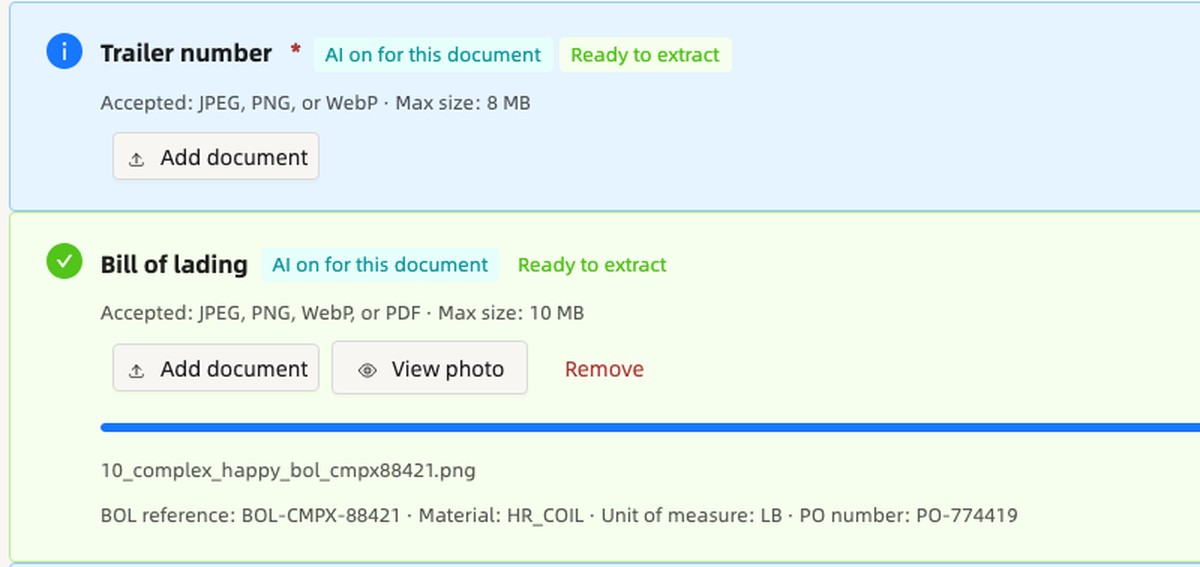
The BOL reference, material, unit and PO number come from the photo. Trailer number and licence plate can be read the same way.
Put your own numbers in
Change the inputs. The sums are shown, and the assumptions are yours.
At the gate
Questions
A fictitious pickup is cargo theft where someone poses as the carrier or driver booked for a load. The booking looks real, a truck arrives, the paperwork looks right, and the freight leaves with the wrong person. Verisk CargoNet counted 138 of 547 thefts in Q3 2026 as fictitious pickups, about 25%.
Common routes are cloning a real carrier's identity from public registry data, hijacking a real carrier's email, bidding on loads under a fake carrier and hiring a real driver, redirecting a driver after pickup, and placing an operative as a driver at a vetted carrier.
A cloned or hijacked carrier can resolve to an active authority with valid insurance. The check has to include the person who arrives and the booking they claim to be on.
Match the truck, carrier and driver to the booking, ask for a one-time pass sent to the booked driver, check the carrier against FMCSA records, require a logged reason when a supervisor admits someone without a pass, and keep photos and timestamps of who came and what left.
When a carrier books a visit and enters the driver's name, phone and e-mail, floDock sends that driver a one-time pass with an 8-character code and a QR. The gate scans or types it. A yard can set it to off, optional or required, and every send, scan, refusal and override is logged.
Tell us about your gates and docks. We will walk through booking, pass, gate check-in and the record it leaves.
Talk to our team